 by
by Quick Answer: A Remote Notary for Legal Documents allows eligible documents to be notarized online through secure identity verification and live video interaction with a commissioned notary. Individuals can often upload documents, verify identity, complete signing remotely, and receive finalized notarized documents from wherever they are, instead of visiting a physical office.
Legal documents should be treated carefully. Most people already spend time gathering paperwork, reviewing information, signing forms, and making sure everything is completed correctly. Then comes the final step: getting it notarized. And suddenly you’re finding a location, scheduling an appointment, driving, waiting, signing, and then driving back. That’s exactly why more people are asking a different question in 2026: Can I use a Remote Notary for Legal Documents instead?
The answer is yes for many situations. Remote notarization continues changing how people complete legal paperwork by making notarization more flexible, more accessible, and often easier to fit into everyday life.
So, let’s understand how a Remote Notary for Legal Documents works, what documents commonly qualify, how the process happens, and how services like eNotary On Call simplify the experience.
What Is a Remote Notary for Legal Documents?
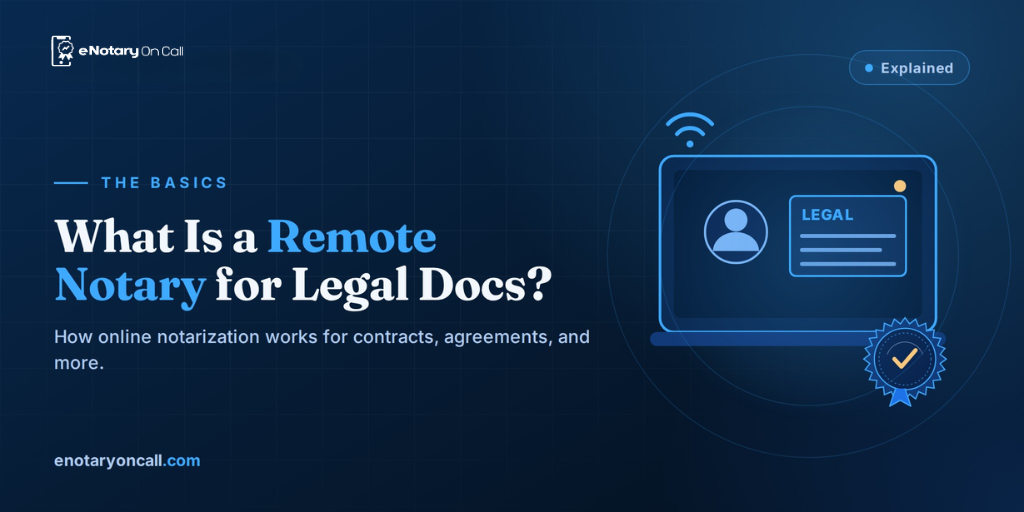
A Remote Notary for Legal Documents enables notarization to occur remotely via secure digital processes rather than requiring everyone to meet in person. Instead of visiting an office, the process generally includes –
- Uploading documents
- Verifying identity
- Joining a live session
- Signing electronically
- Receiving completed documents
The purpose of notarization remains unchanged. The process is becoming more convenient.
Why More Legal Documents Are Being Notarized Remotely in 2026?
People are not switching because documents have become less important. They’re switching because expectations have changed. People increasingly expect faster processes, less travel, flexible scheduling, and digital convenience.
Traditional notarization often creates delays through commutes, office hours, appointments, and coordination. Remote notarization removes much of that friction.
Why It Matters: Legal paperwork already requires attention. Getting documents notarized should not become the hardest part.
What Types of Legal Documents Can Use Remote Notarization?
Many legal documents may qualify. Examples often include Power of Attorney, affidavits, travel consent forms, living wills, Advance Directives, financial authorization, real estate documents, estate planning paperwork, business agreements, and identity agreements.
Key Insight: Eligibility depends on applicable requirements and document acceptance standards, not simply whether the document is digital.
How Remote Notarization Works in 2026?
People often imagine complicated technology. The actual process is usually much simpler.
Step 1 – Prepare Your Legal Document: Before starting, review names, confirm dates, complete required sections, and leave signature areas blank. Do not sign early. Signing before meeting the notary may require repeating the process.
Step 2 – Upload the Document: Once ready, upload the completed document securely. Review file quality, page order, and completeness. So, take a final review before uploading to avoid having to restart later.
Step 3 – Verify Your Identity: Identity verification remains one of the most important parts of remote notarization. You may be asked for a driver’s license, passport, and government-issued identification. Additional verification steps may apply. Remote notarization changes location, but not the identity standards.
Step 4 – Join the Live Notary Session: During the session, the notary generally reviews identity, confirms willingness, witnesses signatures, and completes notarization. The interaction is not automated. Remote does not mean informal.
Step 5 – Sign Electronically: Apply your signature and complete final execution steps, once instructed. The notary then finalizes the process.
Pro Tip: Review every page before completing the session.
Step 6 – Receive Your Completed Document: Download finalized records, save backups, and store securely after notarization. Digital completion often makes future document retrieval easier.
Why Remote Notary Is Becoming the Preferred Option?
People increasingly realize that the biggest inconvenience was never notarization. It was everything around it. Remote notarization helps reduce travel, scheduling, waiting, office visits, and interruptions.
Why It Matters: The easier a process becomes, the more likely people are to complete important legal planning.
When Remote Notary Makes the Most Sense?
Remote notarization may be especially helpful for –
- Busy Professional – Avoid unnecessary interruptions.
- Parents – Reduce extra errands.
- Elderly Individuals – Minimize transportation challenges.
- Remote Workers – Complete documents from home.
- Travelers – Finish legal paperwork without changing plans.
Key Insight: Convenience becomes especially valuable when timing matters.
When Is Traditional In-Person Notarization Still Helpful?
Remote is not automatically the right answer every time. Some situations may still favor in-person execution. Examples include –
- Physical document handling
- Technology limitations
- Personal preferences
- Certain document requirements
Why It Matters: The best notarization method is the one that ensures the document is completed correctly.
Common Mistakes That Delay Remote Legal Notarization
- Signing Before the Session
- Uploading Incomplete Documents
- Using Expired Identification
- Waiting Until Deadlines
- Assuming Every Document Has Identical Rules
Key Insight: Preparation often matters more than the technology.
Is Remote Notarization Secure?
People often assume that it must be less secure when done online. But remote notarization generally relies on structured verification and execution procedures. Processes may include identity verification, authentication procedures, and recorded execution environments.
Why It Matters: The goal is not to reduce the standards. It is to reduce unnecessary friction.
How Remote Notary Saves Time in Real Life?
Traditional involve driving, parking, waiting, signing, and driving back. The remote notarization process includes uploading, verifying, and signing, and that’s it. People usually save more time removing travel than removing signatures.
Why More People Are Choosing eNotary On Call?
Many users choose eNotary On Call to simplify legal paperwork. Benefits may include remote access, flexible scheduling, reduced travel, secure verification, and faster completion. People rarely enjoy document logistics. They just want them finished.
Final Thoughts
Using a Remote Notary for Legal Documents in 2026 has become a practical solution for people who want legal paperwork completed more efficiently, so it is no longer an alternative. Remote notarization allows you to complete many documents from wherever you already are, instead of planning your day around appointments and travel.
And notarization becomes less about logistics and more about getting important legal work finished with eNotary on Call.
Frequently Asked Questions
1. What is a Remote Notary for Legal Documents?
A Remote Notary for Legal Documents allows eligible legal documents to be notarized remotely via identity verification and live interaction, eliminating the need for in-person meetings. The purpose of notarization stays the same while the experience becomes more flexible.
2. Can legal documents really be notarized remotely?
In many situations, yes. Documents such as powers of attorney, affidavits, healthcare forms, and authorization documents are commonly completed remotely. Acceptance requirements should still be reviewed based on intended use.
3. Is remote notarization legally recognized?
Remote notarization follows formal execution and verification procedures designed to support the legal recognition of notarized documents. Requirements and acceptance standards may still vary depending on document type and circumstances.
4. What identification is required?
Government-issued identification, such as a driver’s license or passport, is commonly used during identity verification. Remote notarization changes where signing happens, not the need to confirm identity.
5. Is remote notarization faster than visiting a notary’s office?
For many people, yes. Eliminating travel and reducing scheduling coordination often makes the process feel much more efficient. Actual signing may take only minutes, but the surrounding logistics usually take more time.