 by
by Quick Answer: Construction Lien Waivers are legal documents used in construction projects to confirm that payment has been received and that certain lien rights are being waived. There are multiple types, including conditional and unconditional waivers for both progress and final payments. Although notarization is not always required, it can strengthen execution and improve acceptance depending on project requirements.
So, a Construction projects involve more than materials, labor, and deadlines. They also involve paperwork. And one document that causes more confusion than most people expect is the Construction Lien Waiver. You make the payment, clear the invoices, and get your work completed, but then someone requests a lien waiver, and suddenly, questions start appearing
- What exactly am I signing?
- Does signing remove all rights?
- Do I need notarization?
- What’s the difference between conditional and unconditional waivers?
Mistakes in lien waivers can become expensive because these documents may directly affect payment rights and legal claims. So, let’s understand Construction Lien Waivers, the different types, what they should include, and how to get them notarized quickly, including online through eNotary On Call.
What Are Construction Lien Waivers?
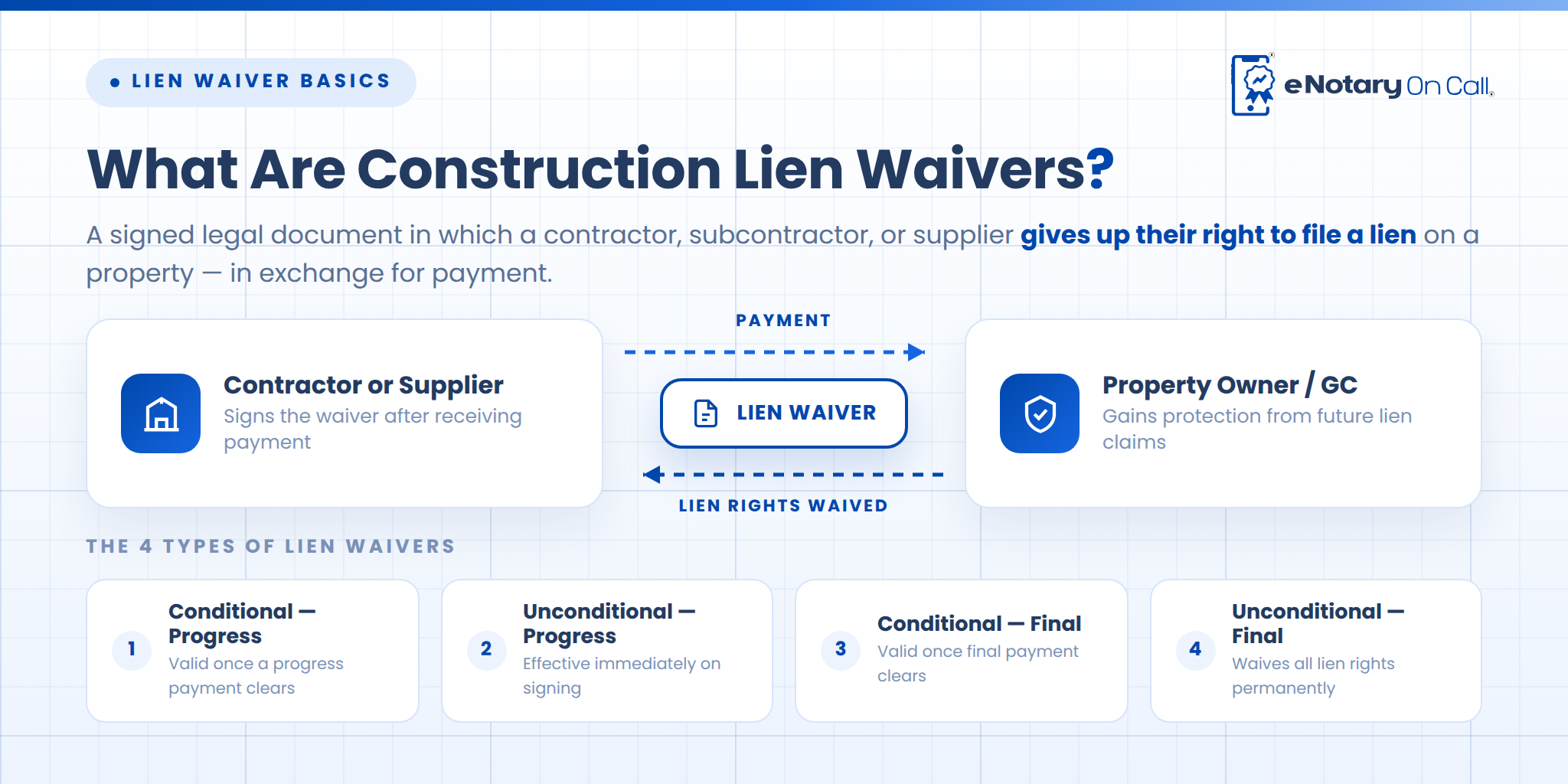
Construction Lien Waivers are legal documents used in construction projects to confirm that a contractor, subcontractor, supplier, or other party waives certain lien rights in exchange for payment. A construction lien (sometimes called a mechanic’s lien) is a legal claim against property for unpaid work or materials.
A lien waiver does not necessarily mean payment never existed. It usually means –
- Payment was received
- Certain lien rights are released
- Claims may be reduced or eliminated
Key Insight: A lien waiver is not the same as a lien release. A waiver often occurs during the payment process, not necessarily after every obligation is completely finished.
Why Construction Lien Waivers Matter
Construction projects involve multiple parties. For example, property owners, general contractors, subcontractors, suppliers, and lenders. Payment disputes can become complicated.
Lien waivers help track payments, reduce disputes, clarify obligations, and support project completion.
Why It Matters: Many parties assume payment alone removes legal risk. In reality, documentation often determines whether rights remain enforceable.
The 4 Main Types of Construction Lien Waivers
- Conditional Waiver and Release on Progress Payment – This waiver becomes effective only after the payment actually clears. It is commonly used when –
- Partial work is completed
- Progress payments are made
- Future work remains
Rights are waived only if payment occurs. It makes sense when there are ongoing construction projects, multiple payment stages, or reduced payment risk. Conditional waivers offer greater protection because rights remain until funds are received.
- Unconditional Waiver and Release on Progress Payment – This waiver confirms that rights are waived immediately regarding progress payments. It is often signed after payment is received. It is typically used after payment completion and during ongoing project phases. Signing too early may unintentionally waive rights before funds are actually secured.
- Conditional Waiver and Release on Final Payment -This applies to the final project payment. The waiver becomes effective only once the final payment is successfully completed. It is used when the work is complete or when the final balances remain pending. Conditional final waivers help protect contractors from prematurely releasing rights.
- Unconditional Waiver and Release on Final Payment – This is often the broadest waiver. It confirms that the final payment has been made and that lien rights are released. Recovery options may become limited after signing. People often sign unconditional final waivers without fully understanding how much protection they are giving up.
What Should Construction Lien Waivers Include?
A complete waiver usually contains several important sections.
- Project Information – It includes the property address, project name, and contract reference.
- Party Information – It identifies the property owner, contractor, subcontractor, and supplier.
- Payment Details – It includes the amount received, payment date, and the covered period. Ambiguous payment language creates disputes later.
- Waiver Language – Clearly state the rights being waived, conditions attached, and effective dates.
- Signature Section – It includes authorized signatures, dates, and notary language if applicable. Never sign incomplete waivers expecting details to be added later.
Do Construction Lien Waivers Need to Be Notarized?
The answer is not always. Requirements may depend on state rules, project agreements, lender requirements, or recording procedures. Even when optional, notarization may help confirm identity, strengthen authenticity, reduce disputes, and improve document reliability.
Why It Matters: Large construction projects often prefer stronger documentation standards.
How to Get Construction Lien Waivers Notarized Quickly
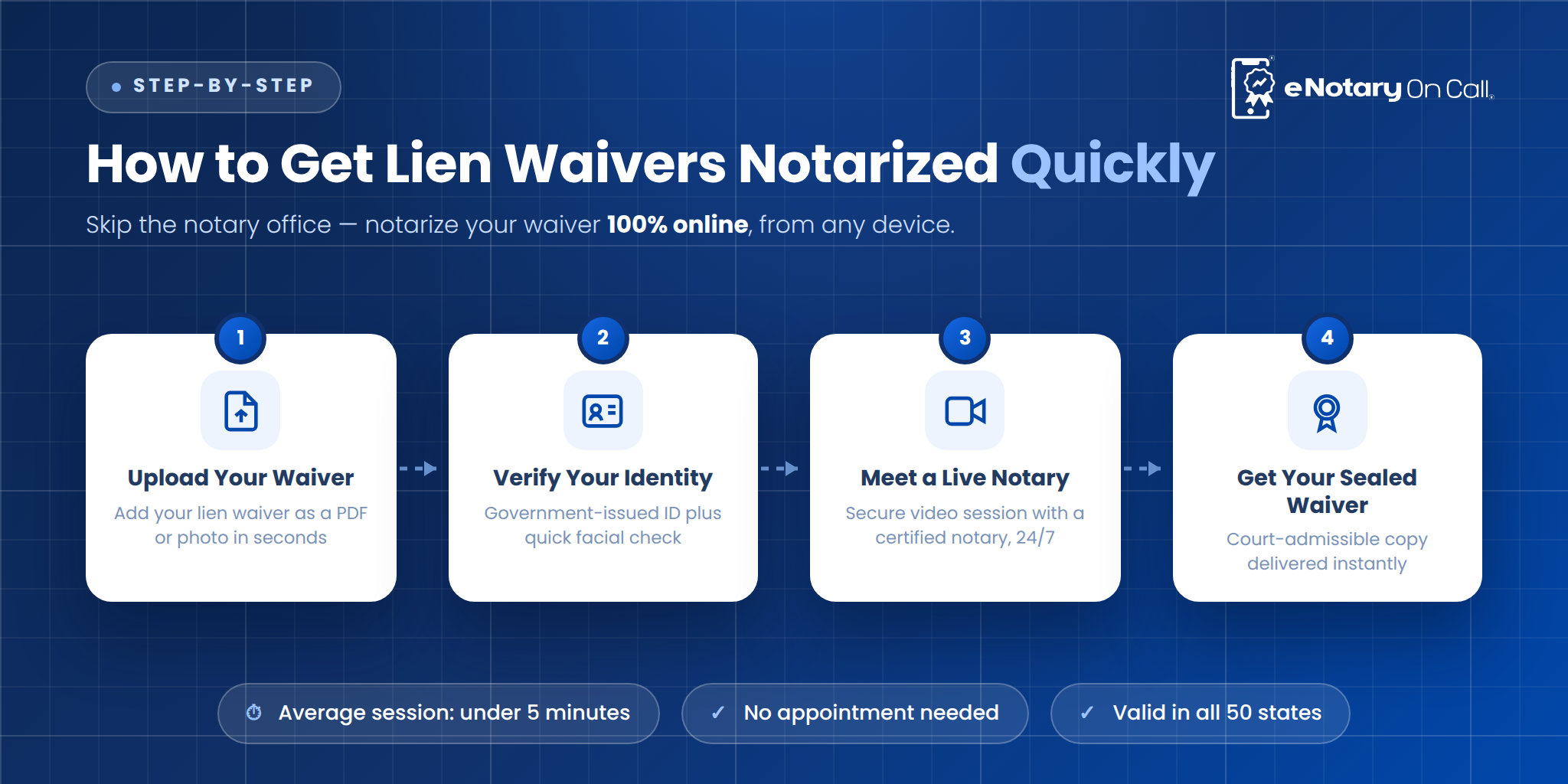
Notarization is usually straightforward once the waiver is complete.
Step 1 – Review the Waiver Carefully: Before signing, confirm payment details, verify dates, and review waiver scope.
Step 2 – Gather Identification: Prepare a driver’s License, passport, and government-issued ID.
Step 3 – Meet With the Notary: The notary generally confirms identity, witnesses signing, and completes certification.
Can Construction Lien Waivers Be Notarized Online?
Yes, in many situations. Online notarization allows parties to complete execution remotely. With eNotary On Call, the process may generally look like this –
- Upload the completed waiver
- Verify identity
- Meet with a commissioned notary
- Sign remotely
- Receive finalized documents
Common Mistakes People Make with Construction Lien Waivers
- Signing Before Payment Clears
- Using the Wrong Waiver Type
- Waiving More Rights Than Intended
- Ignoring State-Specific Requirements
- Forgetting to Keep Records
Key Insight: Lien waivers look simple, but small wording differences can significantly change legal rights.
How Long Should You Keep Construction Lien Waivers?
Retention periods vary, but many parties keep records until:
- Project completion
- Payment verification
- Contract closure
- Applicable record periods expire
Maintain copies of signed waivers, payment confirmation, and supporting contracts. Digital copies often make future dispute resolution easier.
Why Contractors and Property Owners Use eNotary On Call
Many users choose eNotary On Call for faster execution and fewer scheduling delays. Benefits may include remote notarization, flexible scheduling, secure identity verification, faster completion, and reduced travel requirements.
Why It Matters: Construction projects already involve enough coordination. Document execution should not become another bottleneck.
Final Thoughts
Construction Lien waivers directly affect legal rights and project protection, so it is more than just payment paperwork. Understanding the different waiver types, carefully reviewing requirements, and properly executing waivers can help contractors, owners, and suppliers avoid costly misunderstandings.
And getting lien documents notarized can be one of the fastest and easiest parts of keeping construction projects moving forward with eNotary on Call.
Frequently Asked Questions
1. Are Construction Lien Waivers legally binding?
Yes, Construction Lien Waivers can carry significant legal consequences because they may affect a party’s ability to file or enforce lien rights later. That’s why reviewing payment status and waiver language carefully before signing is important.
2. What is the safest type of lien waiver?
Many people view conditional waivers as lower risk because they generally become effective only after payment conditions are satisfied. This may reduce the risk of giving up rights before funds are actually received.
3. Do Construction Lien Waivers always require notarization?
Not always. Requirements may vary depending on jurisdiction, lender expectations, and project agreements. Even when optional, notarization may strengthen reliability and reduce disputes. Confirm requirements before signing rather than assuming.
4. Can subcontractors sign lien waivers?
Yes. Subcontractors commonly sign Construction Lien Waivers as part of payment procedures during projects. Suppliers and contractors may also use them depending on the project structure. Authority to sign should always be confirmed.
5. What happens if I sign the wrong lien waiver?
Signing the wrong waiver may unintentionally limit payment rights or release claims earlier than intended. Correcting mistakes afterwards may become difficult. Carefully review waiver type, payment conditions, and language before execution.