
 by
by Quick Answer: A Travel Consent Form for Minors should typically include the child’s information, travel dates, destination details, accompanying adult information, parent or guardian authorization, emergency contacts, and signatures. Although notarization may not always be required, it strengthens the document and helps reduce delays with airlines, border officials, schools, and travel authorities.
Travelling with children sounds simple until paperwork becomes part of the trip. A Travel Consent Form for Minors becomes especially important, whether a child is travelling internationally with one parent, flying domestically with grandparents, joining a school program, or travelling with family friends.
Many parents assume verbal permission is enough. But in reality, travel providers and border authorities may request written authorization to confirm that the child is traveling legally and with parental knowledge. That leads to two major questions:
What should a Travel Consent Form include? And does it need to be notarized?
Let’s know exactly what belongs in the document, when notarization matters, common mistakes to avoid, and how parents can simplify the process with eNotary On Call.
What Is a Travel Consent Form for Minors?
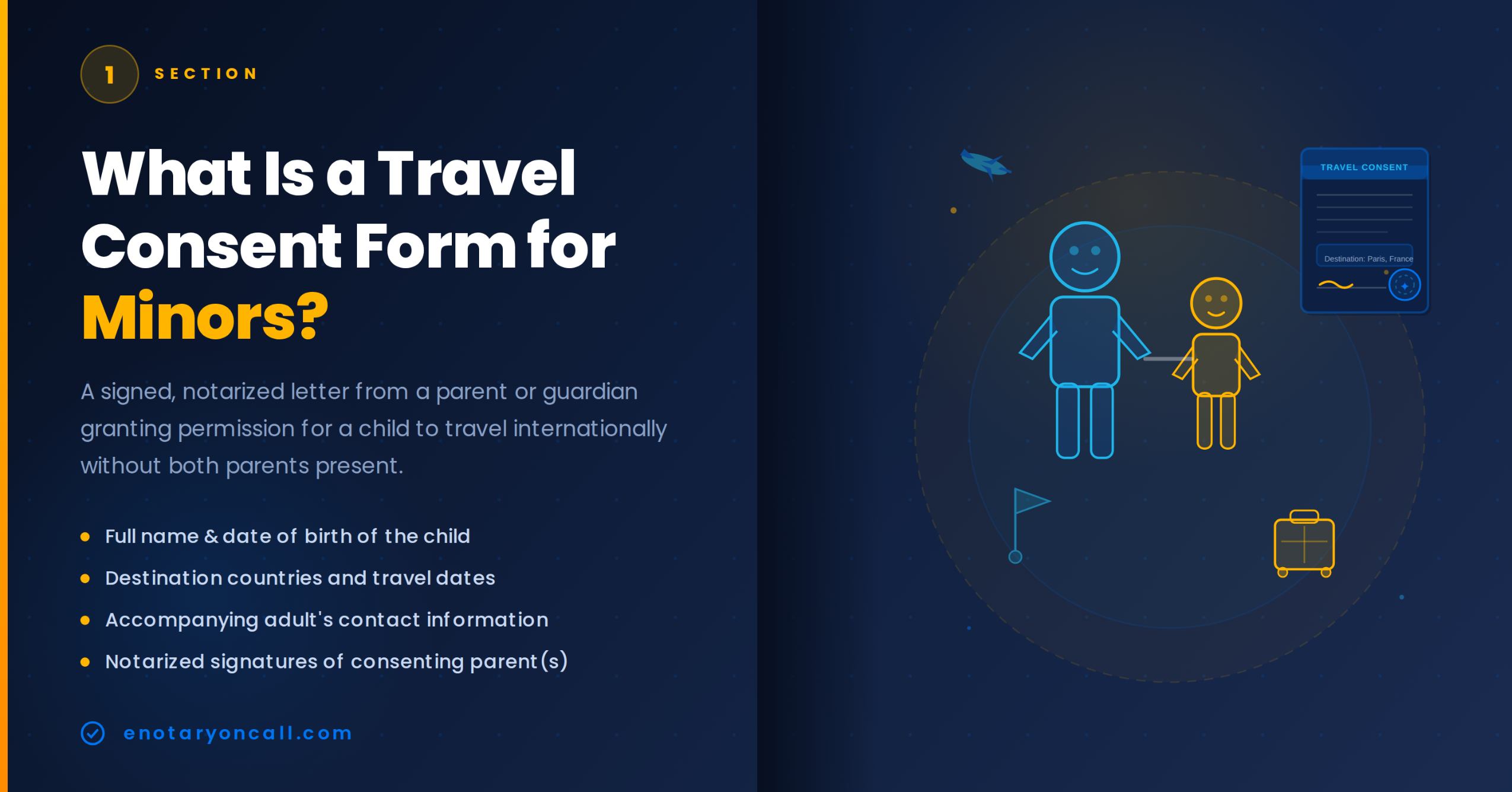
A Travel Consent Form for Minors is a document signed by a parent or legal guardian authorization for a child to travel. It is commonly used when –
- A child travels with one parent
- A child travels internationally
- A child travels with relatives
- A child travels with grandparents
- A child joins a school trip
- A child travels with family friends
- A child travels alone
The purpose is to confirm that the travel is authorized.
Key Insight: Travel consent forms are not only about convenience. They help reduce misunderstandings and support child safety during travel.
Why Travel Authorities May Ask for Consent Documentation?
Travel organizations increasingly focus on child protection. Consent documentation may help address concerns about unauthorized travel, custody disputes, missing parental approval, and identity verification.
Requirements may vary depending on destinations, airline policies, immigration procedures, and custody arrangements.
Why It Matters: Having the document prepared in advance can prevent unnecessary delays at airports and checkpoints.
What Must a Travel Consent Form for Minors Include?
A good consent form should be clear, complete, and easy to verify.
Child’s Full Legal Information – It includes full legal name, date of birth, residential address, and passport information (if applicable). Consistency matters. Names should match travel documents exactly. Small spelling differences create more problems than most parents expect.
Parent or Guardian Information – Include full names, contact information, relationship to child, and addresses. Include relevant authorization details if multiple guardians are involved. Officials want to verify that permission comes from someone legally authorized.
Travel Details – The document should clearly explain the destination, departure date, return date, and transportation information. Avoid vague descriptions. Specific travel information strengthens credibility and reduces questions later.
Accompanying Adult Information – Include full legal name, relationship to child, and contact information if the child travels with someone else. The accompanying adult could be a grandparent, a relative, a teacher, or a family friend.
Authorization Statement – The consent language should clearly state that permission is granted, travel is voluntary, and parents understand travel details. Clarity matters more than legal complexity.
Emergency Contact Information – Include parent phone numbers, backup emergency contact, and alternate communication methods. Travel documents become more useful when someone can actually be reached.
Signature Section – Include parent signatures, date signed, and witness requirements if applicable. Leave signature lines unsigned until execution.
Does a Travel Consent Form Need to Be Notarized?
This is one of the most important questions. The answer is not always, but often it is strongly recommended. Notarization may help verify parent identity, reduce fraud concerns, improve acceptance, and strengthen authenticity.
Key Insight: Travel authorities may treat notarized documents as more reliable even where notarization is optional.
Why Notarization Matters More Than Parents Expect?
Signing alone is not enough for parents. Authorities often need confidence that the signature is genuine, consent was voluntary, and identity was verified. That is where notarization adds value.
Why It Matters: Notarization helps transform a personal permission letter into a stronger legal document.
How to Notarize a Travel Consent Form for Minors?
Step 1 – Prepare the Form – Complete all required sections. Do not sign early.
Step 2 – Verify Requirements – Confirm whether witnesses and additional documents are required.
Step 3 – Gather Identification – Prepare government-issued ID and supporting documents if necessary.
Step 4 – Sign Before the Notary – The notary will verify identity, witness signatures, and complete certification.
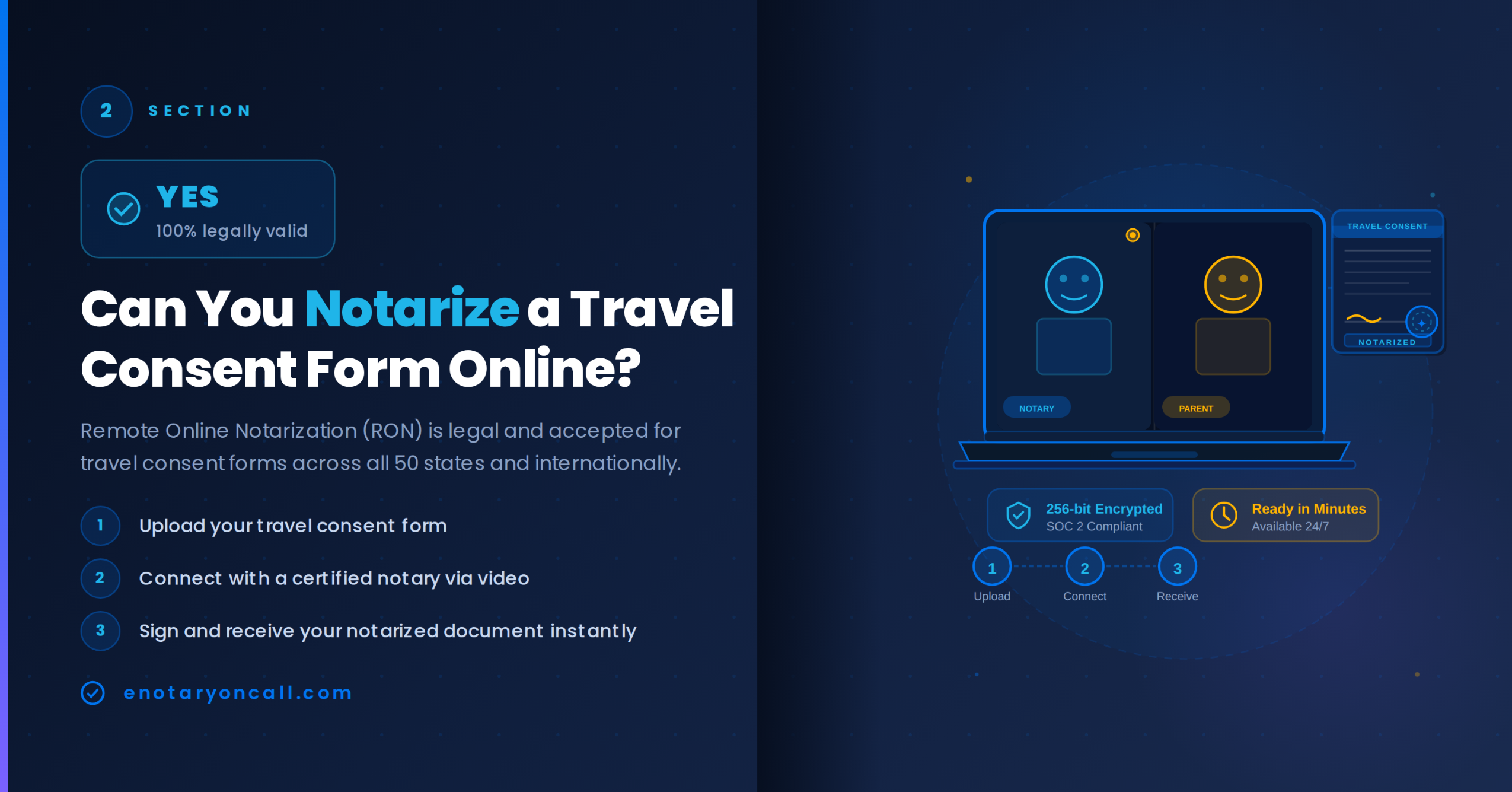
Can You Notarize a Travel Consent Form Online?
In many situations, yes. Online notarization allows parents to complete the process remotely, avoid office visits, and meet with a notary online. With eNotary On Call, the process generally works like this –
1. Upload your document
2. Verify identity
3. Connect with a notary
4. Sign during a live session
5. Receive your notarized document
Why It Matters: Travel preparation already involves enough logistics. Reducing document appointments saves time and stress.
Common Mistakes Parents Make
- Waiting Until Departure Week – Last-minute document preparation creates avoidable stress.
- Using Incomplete Travel Information -Missing dates and details may cause questions.
- Forgetting Supporting Documents – Additional records may still be useful.
- Signing Before Meeting the Notary – Many notarizations require witnessed signatures.
Key Insight: The easiest travel documents are usually the ones prepared early.
When Should Parents Consider Getting Consent Notarized?
Notarization becomes especially valuable when:
- Traveling internationally
- One parent is absent
- Custody arrangements exist
- The child travels with non-parents
- Airline requirements are unclear
Pro Tip: Completing notarization proactively often reduces risk later, if you’re unsure whether it is needed.
Why More Families Are Using eNotary On Call?
Families increasingly choose eNotary On Call for its flexibility. Benefits may include remote access, reduced travel, faster scheduling, secure verification, and convenient completion.
Why It Matters: Parents already coordinate passports, bookings, and itineraries; document logistics shouldn’t become another obstacle.

Final Thought
A Travel Consent Form for Minors may seem like a small document, but during travel, it can become one of the most important pieces of paperwork you carry. Including complete information, preparing it early, and considering notarization can reduce confusion and create a smoother experience for everyone involved.
And getting travel documents notarized can become one of the easiest parts of preparing for the trip with eNotary on Call.
Frequently Asked Questions
1. Does every child need a Travel Consent Form?
Not always. Requirements depend on destination, airline policies, custody arrangements, and who accompanies the child. However, carrying a consent form is often recommended whenever a child travels without both parents.
2. Is notarization legally required for a Travel Consent Form?
Not always. Some situations may not require notarization, but many families still choose it because it strengthens credibility and helps verify identity. Travel providers and border officials may feel more comfortable accepting notarized consent documents.
3. Can grandparents travel internationally with a child using a consent form?
Yes, this is one of the most common uses of a Travel Consent Form for Minors. The document helps show that parents authorized the travel and provides contact information if verification becomes necessary.
4. What documents should travel with the consent form?
Parents often carry copies of passports, birth certificates, custody documents, emergency contacts, and travel itineraries. These documents help support the information included in the consent form.
5. How early should I prepare a Travel Consent Form?
Preparing the document at least several days before departure is usually a good practice. This leaves time to review information, gather supporting documents, and correct mistakes.